The Business Architecture Metamodel: The Complete Guide to Structuring Complexity
Capabilities, value streams, information, strategy: the illustrated reference guide to building a business architecture metamodel that actually drives decisions — aligned with BIZBOK® and the OMG Business Architecture Core Metamodel (BACM).

Mohammed Fellah
Enterprise Architect
Inside any large organization, the same words mean a thousand different things. Ask ten executives what a 'customer', a 'product' or an 'offer' is and you'll get ten answers. That ambiguity quietly destroys strategy execution, transformation programs and data quality. A business architecture metamodel exists to fix exactly that: it gives you a common, stable, formal language to describe what the business does and how it creates value.
This guide distills the Business Architecture Metamodel Guide v3.0 published by the Business Architecture Guild® (September 2024) and translates it into plain language, with the key diagrams. The goal is simple: a practical reference you can use to start or consolidate your own metamodel — without drowning anyone in jargon.
What a metamodel really is, in plain words
A model represents reality (think: the floor plan of a factory). A metamodel is the model of the model: it sets the rules — which concepts are allowed, how they relate, what is permitted or forbidden. It's the grammar of your business architecture.
Without a metamodel, every team invents its own concepts. With one, everyone speaks the same language: a 'capability' means the same thing for strategy, IT, finance and HR. That is what makes it possible to cross views, trace impacts and industrialize analyses across the enterprise.
The v3.0 guide aligns its grammar with the Object Management Group standard, the Business Architecture Core Metamodel (BACM). You inherit a coherent, recognized framework that talks natively to neighboring disciplines (process, customer experience, requirements, IT).
The 10 foundational domains of business architecture
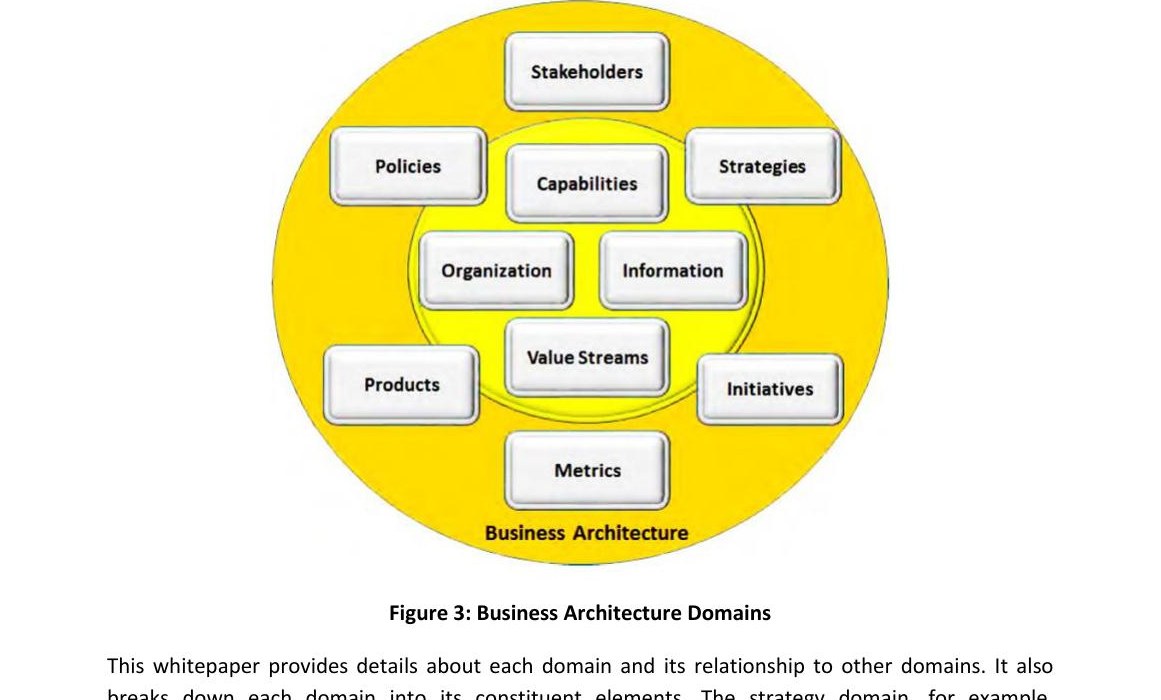
Business architecture is structured around ten complementary domains. Together, they describe the enterprise as an ecosystem: what it knows how to do, how it delivers value, who is involved, what it produces, and against which goals.
At the center sits the capability. It is the focal point that connects everything else. Around it rotate value streams, information, organization, stakeholders, strategy, initiatives, policies, products and metrics.
Capability: the pivot of the entire metamodel
A capability describes what the organization knows how to do, independent of who does it, how, or with which tools. 'Manage Customer', 'Design Product', 'Execute Payment' are capabilities. They are remarkably stable over time: payment methods change, the capability 'Execute Payment' stays.
That stability is precious. It lets you plan over multi-year horizons without being held hostage to technology trends. Each capability is realized through one or more instances (concrete implementations), produces outcomes, and exhibits observable behaviors. This is the natural lens for root cause analysis: when a customer outcome degrades, you trace it back to the capability instance that's underperforming.
Why is capability central? Because every other dimension hangs off it: a value stream mobilizes it, information feeds it, an organizational unit owns it, a strategy invests in it, a policy constrains it, a product depends on it.
The Business Architecture Framework™: knowledgebase, blueprints, scenarios
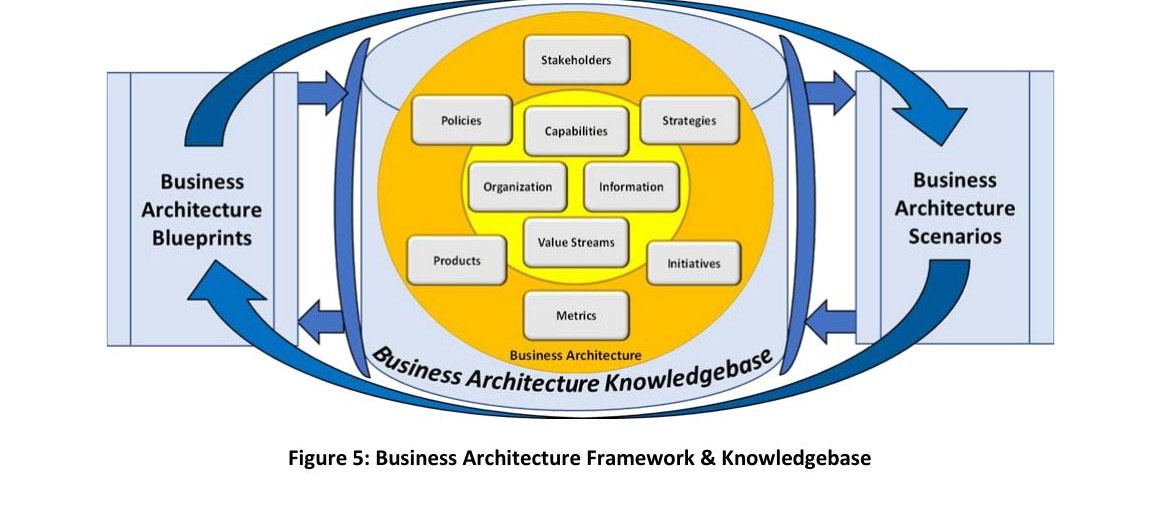
A metamodel doesn't live alone. It sits inside a three-layer framework: a knowledgebase (the structured base of facts), blueprints (the views extracted from it), and business scenarios (the use cases that drive which blueprints to produce).
In practice: capture data once in the knowledgebase; extract as many views as you need (capability map, strategic heatmap, initiative impact); and let each scenario — merger, product launch, digital transformation — pull the relevant blueprints. That's how business architecture stops being a one-off deliverable and becomes a durable enterprise asset.
Value streams: the business in motion
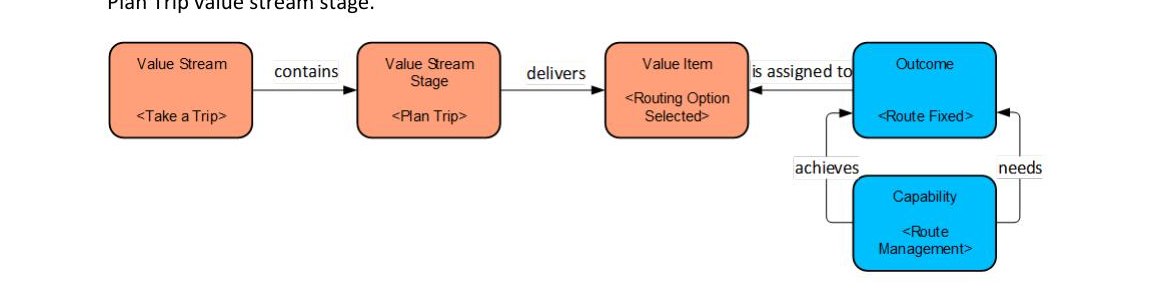
A value stream represents the end-to-end journey through which a stakeholder (often the customer) receives value. It is triggered by a stakeholder, traverses several stages, and concludes with a tangible value proposition.
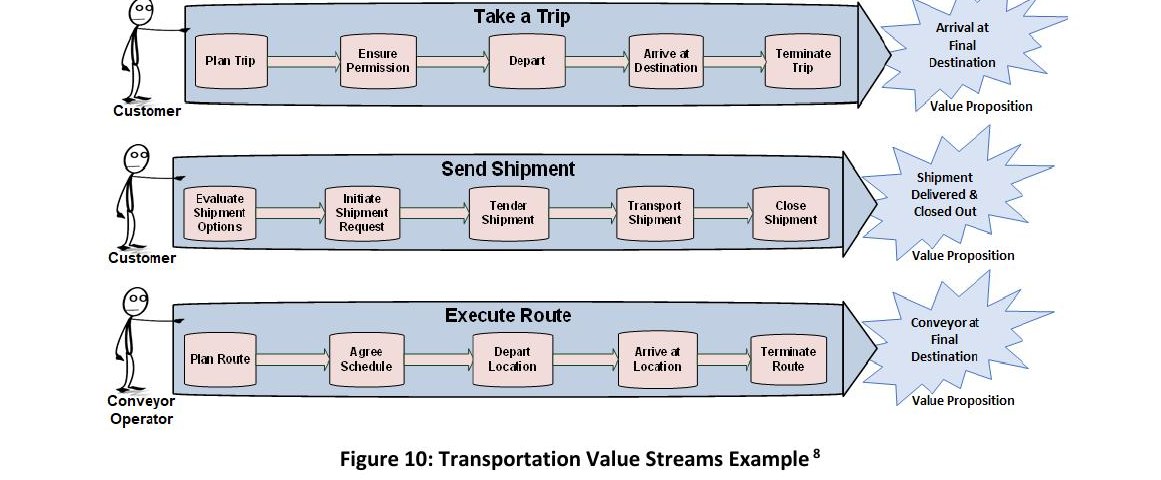
If capability describes the business at rest, value stream describes it in motion. At each stage, capabilities are mobilized to produce value items (intermediate deliverables) that move the customer toward the final outcome. Modeling this makes visible what creates — or destroys — value.
The example below shows three value streams from a commercial airline: 'Take a Trip' (passenger journey), 'Send Shipment' (cargo) and 'Execute Route' (operational delivery). One enterprise serves multiple stakeholders through multiple value streams — that's normal, and it's exactly what reveals the real complexity of the business.
Information: business objects, not database fields
The information domain captures the business objects an organization handles: 'Customer', 'Contract', 'Itinerary', 'Shipment'. We are not talking about database tables; we're talking about shared business notions whose definition must be stable and unique across the enterprise.
Each information concept has states (in progress, validated, closed), relationships with other concepts, and participates in many capabilities. When you unify these definitions, you eliminate semantic silos: finance, marketing and operations finally talk about the same 'customer'.
A capability map: the highest-ROI deliverable you can produce
The capability map is the first artifact I put on the table. It's a hierarchical decomposition (level 1, 2, 3) of what the enterprise knows how to do. The upper levels are conversation tools for the C-suite; the deeper levels instrument detailed analyses (impact, redundancy, investment).
A good capability map fits on a single A3 page and immediately surfaces the right questions: where are we concentrating investment? Where do we have application overlap? Which capabilities are strategic but under-supported? It is the most powerful framing tool I know.
The extended domains: organization, strategy, initiatives, policies, products
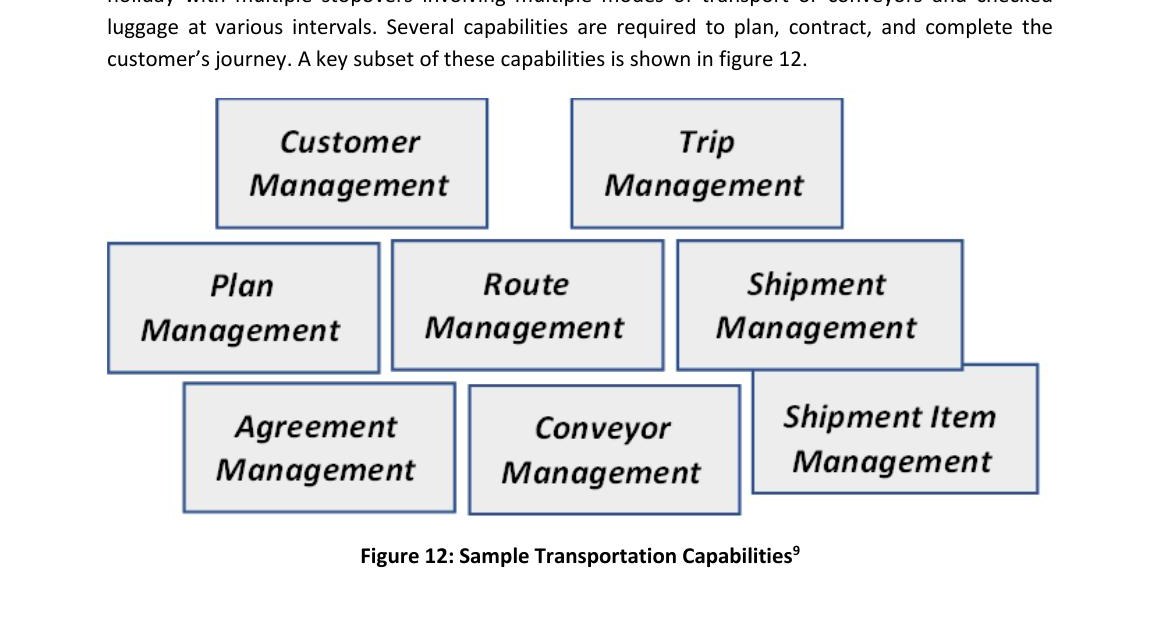
Around the capability / value stream / information core, six other domains complete the picture and anchor the architecture in the reality of governance.
- Organization: units, teams and partners that own capabilities. The capability × organization crossing reveals gray zones and overlaps.
- Stakeholders: actors (customers, employees, partners, regulators) who trigger or receive value.
- Strategy: objectives, courses of action, assumptions. Linked to capabilities, it converts a vision into an investment plan.
- Initiatives: programs and projects that change the enterprise. Linked to capabilities, they become traceable and arbitrable.
- Policies: internal rules and external constraints (regulations) that frame capabilities.
- Products & services: what the enterprise sells, supported by a set of capabilities and consumed through value streams.
- Metrics: indicators that measure capability, value stream and product performance.
Does this resonate? Let's discuss your situation.
Aligning business architecture with process and IT
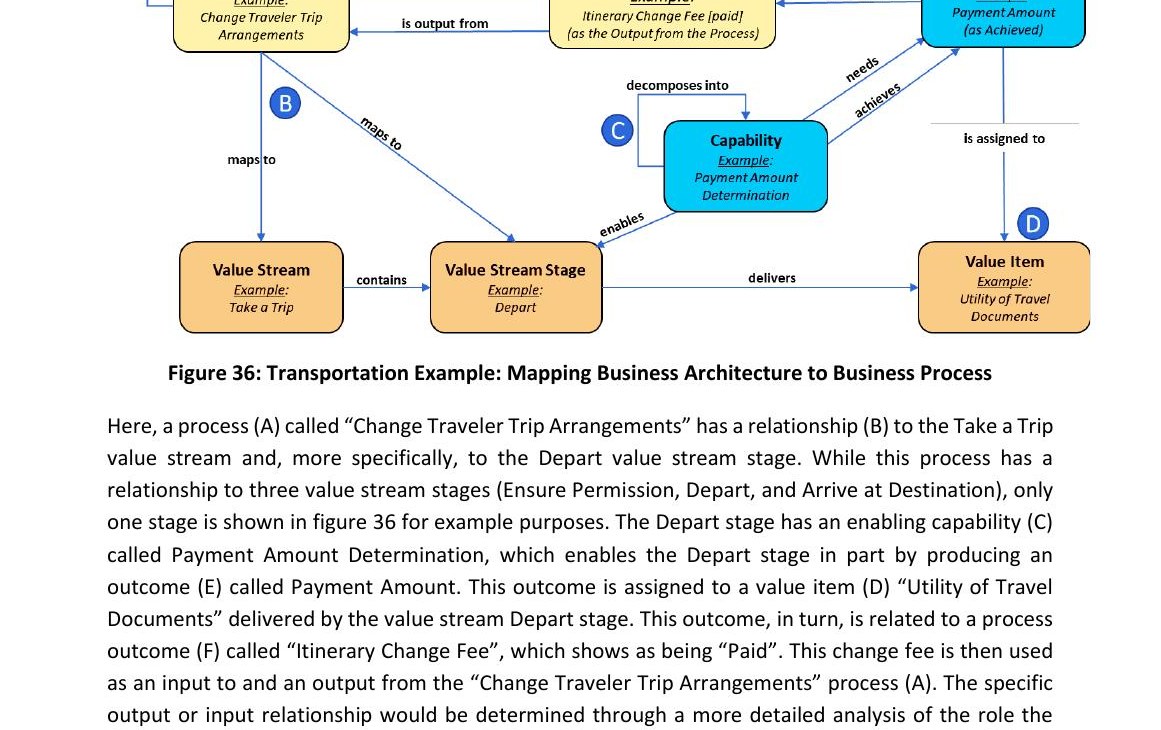
The metamodel reaches its full power when it talks to neighboring disciplines. The v3.0 guide formalizes three key alignments: with requirements management, with customer experience design, and with Business Process Management.
The diagram below shows how a BPMN process ('Change Traveler Trip Arrangements') connects to a value stream stage ('Depart'), to an enabling capability ('Payment Amount Determination') and to a value item ('Utility of Travel Documents'). This web of links is what makes business architecture executable: you no longer just describe — you connect every process, application and team to the value they serve.
How to start: a 5-step playbook
1. Frame the ambition
Pick the priority business scenarios (transformation, M&A, application rationalization…). The metamodel is deployed to support decisions, not to win design awards.
2. Start minimalist
Five to seven concepts are enough at day one: capability, value stream, information, organization, strategy, initiative. Enrich later, by iteration.
3. Build the first capability map
Workshop with 5–8 senior leaders. Levels 1 and 2 only. Goal: a shared agreement on what the enterprise does. Everything else will hang off this map.
4. Tool the knowledgebase
A single repository (MEGA, Bizzdesign, Ardoq, Sparx EA…) instead of scattered PowerPoints. Traceability does not survive in slides.
5. Keep the model alive
Quarterly review, clear governance, named domain owners. A living metamodel is one that gets used.
Common pitfalls to avoid
- Trying to model everything before producing any value. Eighty percent of the value lives in twenty percent of the concepts.
- Confusing capability and process. Capability describes the 'what', process describes the 'how'. Mixing them ruins traceability.
- Working without a business owner. Without a sponsor, the metamodel stays an IT artifact with no strategic reach.
- Over-engineering the knowledgebase. A simple repository, fed continuously, beats a perfect model that's never updated.
Why this really matters
A well-built metamodel is not a deliverable: it's an asset. It accelerates diagnostics, sharpens investment trade-offs, de-risks transformations and finally gives a common language to organizations that have grown too complex to be steered by gut feel.
The Business Architecture Metamodel Guide v3.0 provides the reference grammar. The job — and the value — is to put it to work in service of your decisions, not your next slide deck.
Key Takeaways
- 01The metamodel is the grammar that makes the enterprise readable, traceable and steerable
- 0210 domains, capability at the center: value streams, information, organization, strategy, initiatives, policies, products, stakeholders, metrics
- 03Capability = what the business knows how to do (stable); process = how it does it (changing)
- 04BIZBOK® / BACM framework: one knowledgebase, many blueprints, targeted business scenarios
- 05Start minimalist (5–7 concepts), iterate, keep the model alive through quarterly reviews
- 06Explicitly align process, requirements and customer experience to make architecture executable
Tools & Frameworks
Mohammed Fellah
Enterprise ArchitectSharing insights from years of hands-on enterprise architecture experience. No theory without practice.