Aligning Business and IT: What the BIZBOK® v3 Metamodel Actually Changes on Engagements
The Business Architecture Guild's whitepaper on Business/IT metamodel alignment puts a cardinal discipline back at the center. Here's what I take from it, from the field.

Mohammed Fellah
Enterprise Architect
We've been talking about Business-IT alignment for thirty years. And yet, according to Genpact Research, nearly $400 billion out of $600 billion spent on digital projects fall short of expectations. Two-thirds of programs are either scrapped or underwhelming. When you read that figure on engagements, you don't find it exaggerated — you see it in every steering committee where nobody can tell you which business capability supports which application, or the other way around.
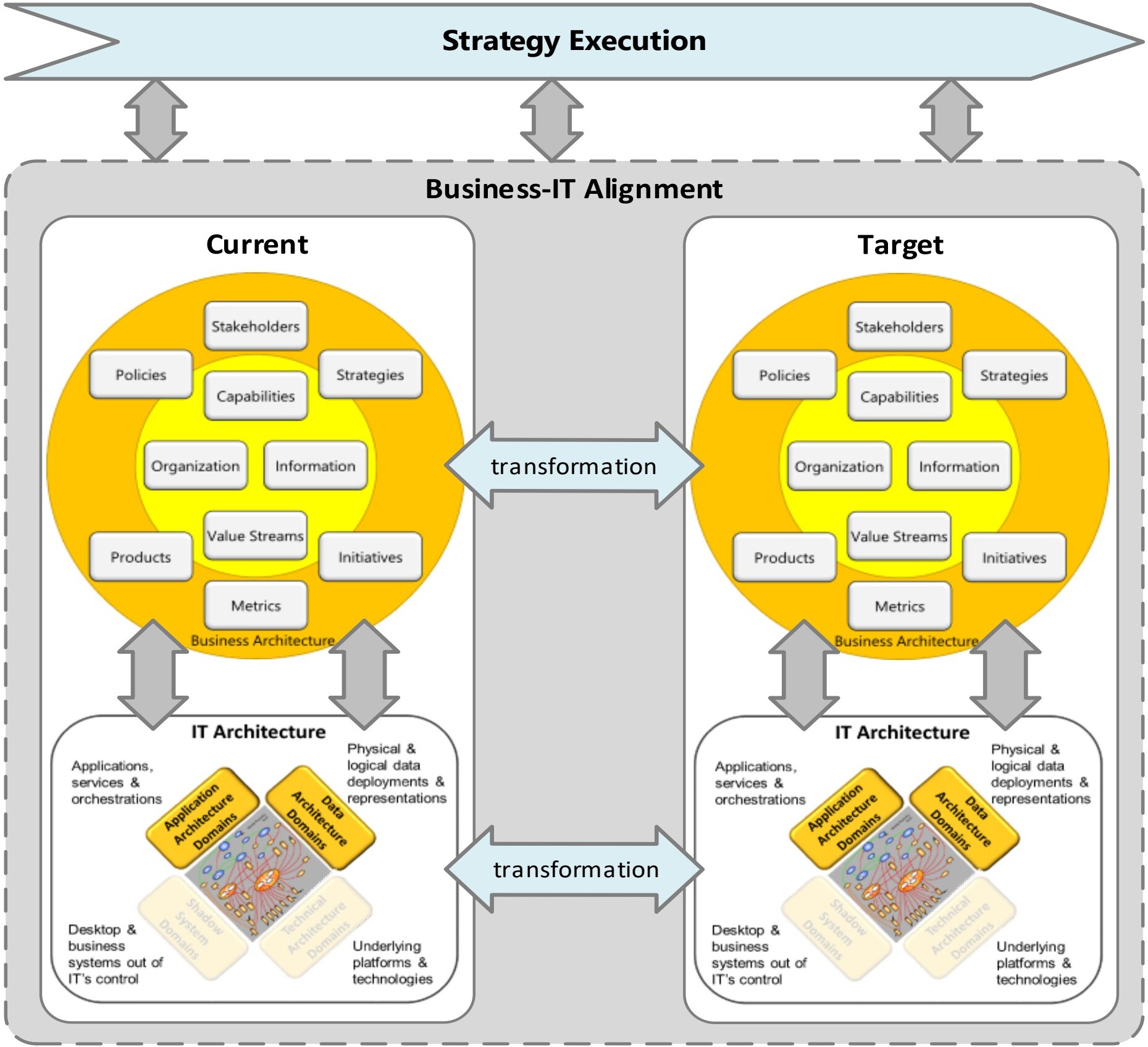
The Business Architecture Guild's September 2025 whitepaper, "Business and IT Architecture Metamodel Alignment," lands at the right time. It doesn't reinvent enterprise architecture. It does something more useful: it formally connects the BIZBOK® v3 metamodel (capabilities, value streams, organization, information) to the IT metamodel (applications, software services, data). That connection is what's missing in 80% of the organizations I walk into.
What I like about the framing is the "current → target" angle. Business architecture describes the current ecosystem, the same metamodel describes the target, and transformation becomes the explicit arbitration between the two. The IT layer (applications + data) is the faithful echo of that transformation. Everything else — shadow systems, technical architecture — is deliberately scoped out. That's healthy: we stop pretending to map everything and start being able to decide.
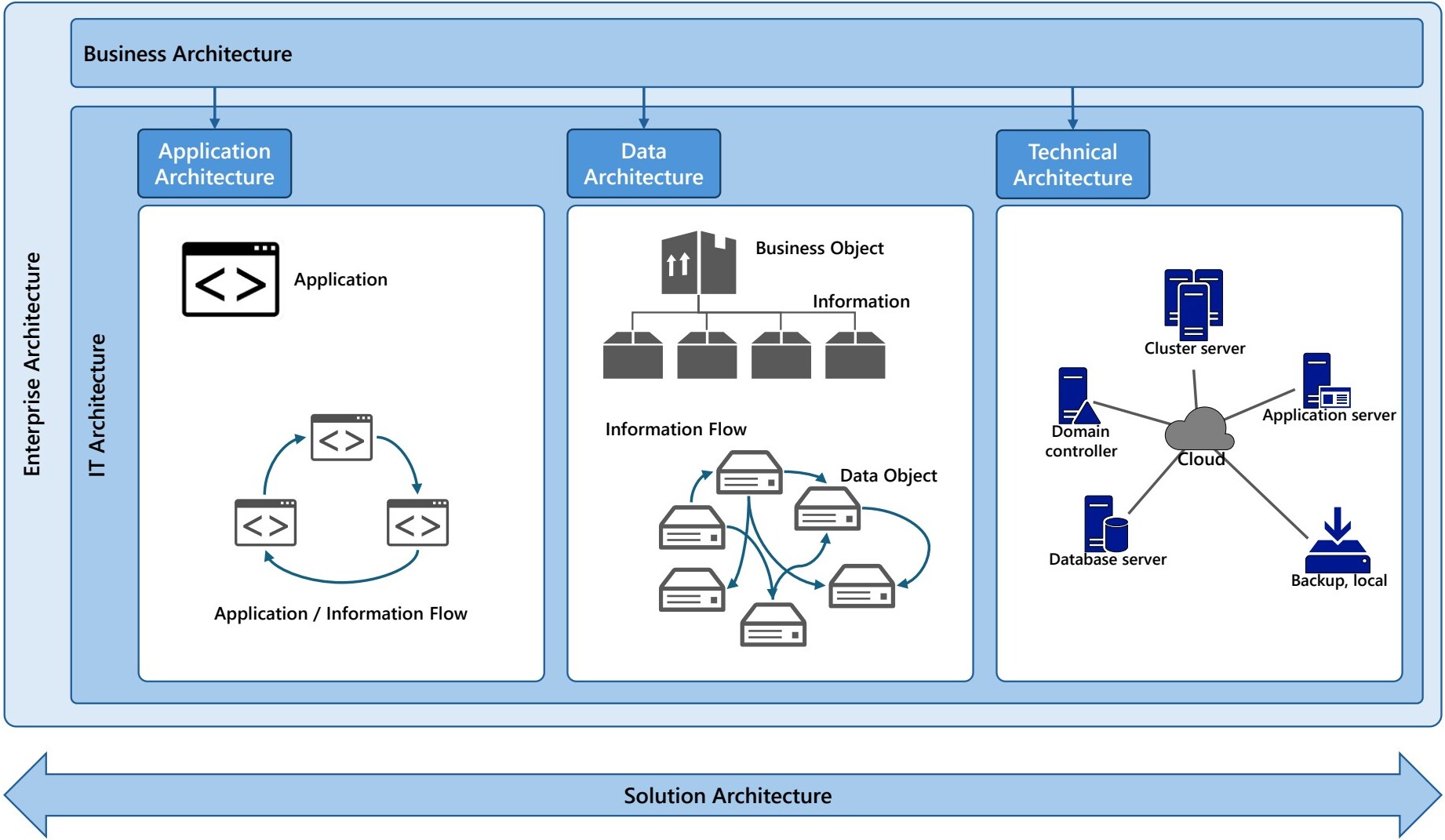
The pivot of the document, and the pivot of my engagements, is the business capability. Not the process, not the application, not the org chart. The capability — because it's stable over time, technology-neutral, and the only concept a CEO, a CIO and a developer can share without misunderstanding. The whitepaper makes it explicitly the "central focal point" of Business-IT alignment.
Concretely, here's how I translate this into engagements. First, I build or audit the level 1-2 capability map. Then I draw the capabilities × applications matrix. Not in Excel. In HOPEX, BizzDesign or LeanIX, leveraging the native "automates" relationship between Application and Capability. That mapping reveals the real decisions: critical capability poorly supported = invest, non-strategic capability over-supported = simplify.
Does this resonate? Let's discuss your situation.
The whitepaper then formalizes the relationships between Software Service, Software Feature, Capability Behavior and Capability Instance. It looks theoretical, but it's exactly what allows you, when scoping a project, to answer the question nobody can settle: "if we automate this capability, how many services impacted, how many features to ship, how many data objects touched?" Without that grammar, you estimate by feel. With it, you estimate on facts.
The data side is just as powerful. The document makes the Business Object the pivot between business information and data architecture. On engagements, this resolves the eternal debate between data architects and business architects: everyone models the same "Customer," the same "Contract," the same "Product." When the business object is shared, data lakes stop being silos parallel to the operational IS.

My honest take on the whitepaper: it doesn't revolutionize anything, but it puts order into a discipline we've let dilute into "digital" buzzwords. For an enterprise architect on the field, it's a serious toolkit. Not to produce more slides — but to finally walk into a committee and say, fact-based: this is what needs to change, this is what it costs, this is the business impact.
Key Takeaways
- 01Business capability is the pivot of alignment — not process, not application
- 02Current → target metamodel: transformation becomes explicit arbitration
- 03Capabilities × applications matrix = foundation for investment decisions
- 04The Business Object reconciles data architecture and business architecture
- 05Scope tightly (no shadow systems, no tech) to decide, not to map everything
Tools & Frameworks
Mohammed Fellah
Enterprise ArchitectSharing insights from years of hands-on enterprise architecture experience. No theory without practice.